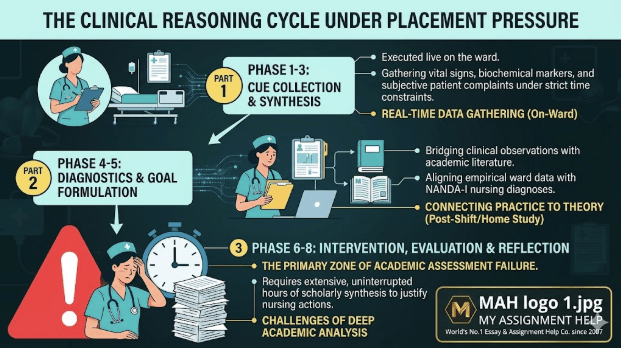
The contemporary landscape of Australian higher education presents structural complexities that test the psychological and physical endurance of undergraduate students. Within this paradigm, individuals pursuing a Bachelor of Nursing encounter a distinct, intensified set of operational demands. Unlike traditional liberal arts or commerce degrees, where academic progress is evaluated primarily through examinations, essays, and seminars, nursing curriculums impose a dual-track framework. Students must simultaneously achieve advanced academic mastery of evidence-based pathophysiological principles and execute rigorous, unpaid clinical placements within acute, sub-acute, and community healthcare environments.
This structural arrangement introduces severe temporal friction. A typical nursing student across institutions such as the University of Sydney, Monash University, or Queensland University of Technology must complete a minimum of 800 hours of clinical placement to meet the professional registration benchmarks mandated by the Nursing and Midwifery Board of Australia (NMBA). When these intensive 40-hour placement weeks intersect with high-stakes research reports, portfolios, and complex pharmacological evaluations, the structural vulnerabilities of the student lifecycle become starkly apparent. To maintain academic progression without succumbing to severe burnout, identifying a supportive, high-tier assignment service operating within the local ecosystem emerges as a pragmatic structural necessity rather than an optional luxury.
The consequences of this systemic friction extend beyond localized academic strain; they manifest as a broader public health and workforce retention vulnerability. As Australia faces critical nursing shortages across regional, rural, and metropolitan health sectors, understanding the structural pressures experienced by undergraduate nursing students is imperative. This comprehensive analysis evaluates the logistical realities of clinical placement poverty, the cognitive loads imposed by modern healthcare curriculums, and the strategic interventions required to secure both clinical competency and academic excellence.
Key Takeaways for Australian Nursing Undergraduates
- The Temporal Crunch: Unpaid clinical placements demand up to 40 hours per week, leaving zero functional operational windows for traditional part-time employment or intensive library research.
- Regulatory Compliance: All academic submissions must perfectly integrate NMBA Registered Nurse Standards for Practice and NSQHS safety dimensions to pass clinical review.
- Cognitive Dissonance: Translating abstract theoretical frameworks (e.g., the Clinical Reasoning Cycle) into high-intensity, live ward environments introduces significant psychological stress.
- Strategic Intervention: Leveraging highly specialized, external academic support networks preserves mental health margins and protects GPA integrity during placement cycles.
1. The Structural Realities of Placements: Evaluating Time Poverty
The operational framework of nursing education mandates absolute immersion in healthcare environments. To ensure public safety and clinical efficacy, the NMBA dictates precise competencies that cannot be simulated within campus laboratories alone. Consequently, students are embedded directly into active clinical teams, rotating through complex clinical shifts including early mornings (0630–1500), late afternoons (1430–2300), and active night duties (2230–0730).
This dynamic creates a profound condition known as placement-induced time poverty. When an undergraduate is rostered on a full-time clinical block—frequently spanning two to six consecutive weeks—the baseline allocation of temporal resources shifts drastically. The mathematical reality of this distribution can be expressed through a simple resource equation:
\mathbf{T_{available} = T_{total} – (T_{placement} + T_{transit} + T_{physiological\_recovery})}
Where T_{total} = 168 hours per week. Assuming a standard 40-hour placement week, an average of 15 hours of regional or metropolitan transit, and a non-negotiable 56 hours for physiological recovery and sleep, the remaining temporal margin is severely compressed. Within this residual block, students must compile comprehensive clinical logs, draft intricate nursing care plans, and prepare for upcoming theoretical assessments.
The economic impact of this operational commitment is equally severe. Because the vast majority of clinical placements in Australia remain entirely unpaid, students experience a sudden collapse in their earning capacity. Those who rely on casual or part-time work in retail, hospitality, or aged care to fund tuition, rent, and basic living expenses find themselves in an unsustainable financial position. This phenomenon, increasingly recognized by peak student bodies as “placement poverty,” forces individuals to make compromising choices between maintaining financial survival and dedicating necessary hours to deep academic research.
See also: How Cloud Computing Is Transforming Modern Businesses
The Multi-Dimensional Impact of Placement Blocks on Nursing Undergraduates
| Domain of Impact | Operational Reality During Placement Blocks | Downstream Academic & Personal Consequences |
| Temporal Distribution | 38–40 hours/week on shift + mandatory clinical debriefs and handovers. | Severe truncation of library research hours; exhaustion prevents cognitive retention. |
| Financial Stability | Zero financial compensation for public hospital shifts; loss of casual work hours. | Inability to meet basic living costs; increased reliance on emergency bursaries or external aid. |
| Cognitive Load | Continuous exposure to high-acuity patient environments and real-time clinical risks. | Elevated cortisol levels; diminished capacity to execute complex academic writing post-shift. |
2. The Cognitive Load of Theory: Decoding Academic Benchmarks
While surviving the physical demands of the ward, the nursing student remains completely tethered to rigid academic benchmarks. Contemporary nursing theory is not merely memorization; it is an advanced, interdisciplinary synthesis of pathophysiology, pharmacology, sociology, and bioethics. Australian universities maintain exceptionally strict criteria for academic progression, requiring all submissions to reflect current evidence-based literature published within the last five years.
Consider the structural demands of an advanced clinical case study assignment. A student is typically presented with a complex patient narrative—for example, a 68-year-old post-operative patient with a history of type 2 diabetes mellitus, chronic kidney disease, and sudden onset acute delirium. The student must analyze this scenario through specific conceptual lenses, such as Levett-Jones’ Clinical Reasoning Cycle. This requires mapping out eight distinct, sequential phases: considering the patient situation, collecting cues, processing information, identifying problems, establishing goals, taking action, evaluating outcomes, and reflecting on the process.
Each phase must be defended using empirical clinical evidence. Writing a 3,000-word paper that satisfies these deep analytical demands requires hours of quiet, focused library research—an environment entirely detached from the sensory overload of a busy emergency department or surgical ward. When a student transitions directly from an exhausting late shift to a computer screen, the risk of structural academic failure increases exponentially. Under these intense conditions, securing the best nursing assignment help becomes a vital strategy to protect your academic standing and ensure your hard work pays off.
3. The Intersection of Policy and Academic Integrity
The academic expectations of Australian nursing schools are anchored directly to national healthcare governance and safety standards. Every written piece—whether an essay on cultural safety in Indigenous healthcare or an analysis of medication administration errors—must be explicitly mapped to the National Safety and Quality Health Service (NSQHS) Standards. These standards govern critical operational areas including clinical handover, medication safety, partner-centered care, and infection control.
Furthermore, academic writing must strictly respect the guidelines set by the Australian Commission on Safety and Quality in Health Care (ACSQHC). For an assignment to secure a high grade, the text must clearly demonstrate how a registered nurse applies these high-level regulatory frameworks at the bedside. For example, when discussing wound care management, the student cannot simply outline an intervention; they must justify it through the lens of NSQHS Standard 8 (Recognising and Responding to Acute Deterioration) and back it up with recent clinical trials.
This level of academic precision leaves absolutely no room for errors, poor phrasing, or weak arguments. Academic integrity units use highly sophisticated pattern-matching software to scan every single submission for authenticity, structure, and original thought. For a student managing an overwhelming schedule, compiling a reference list of 30 peer-reviewed articles using perfect APA 7th referencing formatting represents an immense challenge. Ensuring your submissions are structured accurately, written professionally, and cleanly aligned with national clinical standards requires specialized, elite academic support designed specifically for the unique demands of the Australian curriculum.
4. Strategic Interventions: Restoring Balance and Preserving GPA
To overcome the intense pressures of nursing education, students must move beyond basic time-management tips and implement structural, proactive interventions. Surviving this dual-track system requires a strategic approach that treats academic success and clinical performance as interconnected priorities.
Active Temporal Decoupling
Students must actively insulate their academic writing blocks from their clinical schedules. Rather than attempting to write substantial portions of an assignment after an eight-hour shift, the curriculum should be broken down into discrete, manageable sub-tasks. For example, completing a literature matrix during a weekend rest period ensures that the core research phase is finalized before the physical demands of the placement block begin.
Leveraging Domain-Specific Academic Support
Recognizing when your schedule is overextended is a core skill in professional clinical practice; it should be applied to academic life as well. Engaging specialized support teams ensures that complex structural tasks—such as formatting comprehensive bibliographies, auditing clinical care plans against NSQHS guidelines, and proofreading complex pharmacological arguments—are executed to elite academic standards. This targeted support enables students to focus their limited energy on mastering real-world skills during their hands-on clinical placements.
Proactive Institutional Engagement
When placement schedules conflict directly with major assessment dates, students should engage with university course coordinators well in advance. Providing clear, early documentation of your clinical roster allows you to request formal extensions or adjust assignment timelines through official university channels, preventing the need for stressful, last-minute mitigation strategies.
Frequently Asked Questions (FAQs)
1. How can I complete my university assignments when my clinical placement demands 40 hours a week of shift work?
The key lies in advanced research planning and utilizing specialized academic support services. By compiling your literature reviews and outlining your assignments before your placement block begins, you reduce the required work during busy clinical weeks to simple drafting and editing. For complex or highly technical sections, collaborating with professional academic specialists ensures your papers remain competitive without sacrificing essential sleep or clinical focus.
2. Why are assignments based on Levett-Jones’ Clinical Reasoning Cycle graded so strictly by Australian universities?
The Clinical Reasoning Cycle is the fundamental diagnostic framework used to evaluate clinical safety and decision-making under national standards. Academic assessors look for clear, evidence-based links between your bedside observations (cues) and your actual nursing interventions. Missing a single phase or failing to back up your decisions with recent peer-reviewed literature demonstrates a gap in safe clinical reasoning, which leads to strict grading penalties.
3. Can I apply for an academic extension if my clinical placement roster includes intensive night shifts?
Yes. Most Australian universities have clear processes for adjusting timelines when placement schedules create significant conflicts. However, these requests must be submitted proactively, usually at least one to two weeks before the assignment deadline. You will need to provide official copies of your clinical roster signed by your venue facilitator to demonstrate how your shift hours directly impact your ability to complete your academic work.
4. How do national safety and quality standards impact my assignment grades?
National healthcare standards, such as the NSQHS guidelines, are foundational to professional practice across Australia. Your assignments must demonstrate more than just basic textbook knowledge; they must show that you understand how to apply these safety frameworks in active clinical environments. Ensuring your arguments are closely aligned with these official regulations is essential for reaching higher grade brackets.
References & Evidence Base
- Australian Commission on Safety and Quality in Health Care (ACSQHC). (2021). National Safety and Quality Health Service (NSQHS) Standards (2nd ed.). ACSQHC, Sydney.
- Levett-Jones, T. (2020). Clinical Reasoning: Learning to think like a nurse (2nd ed.). Pearson Australia, Melbourne.
- Nursing and Midwifery Board of Australia (NMBA). (2016). Registered nurse standards for practice. AHPRA, Melbourne.
- Royal College of Nursing Australia (RCNA). (2024). The Economic Reality of Undergraduate Nursing Placements: A National Survey of Financial Strain and Placement Poverty. RCNA Research Press, Canberra.
About the Author
Dr. Evelyn Macpherson is a Senior Academic Content Strategist and regular research contributor at MyAssignmentHelp. She holds a PhD in Nursing Education from the University of Melbourne and has over twelve years of active experience teaching undergraduate clinical units across major Australian universities. Dr. Macpherson specializes in aligning student academic writing with professional NMBA competencies and NSQHS standards, helping the next generation of healthcare professionals successfully bridge the gap between complex nursing theory and hands-on clinical practice.